When Not to Use DDD
Seven situations where DDD does not belong, with alternatives, code samples, and a decision tree. For developers who do not want to load a project with needless complexity.
In this chapter
This chapter is a decision framework: when to adopt DDD and when not to. Mistakes in code once DDD is already in place are cataloged in Anti-Patterns and Common Mistakes. The operational friction with Doctrine, Messenger, and Symfony, where DDD is applied correctly but the infrastructure hurts, is the subject of DDD in Practice – Where It Hurts.
DDD is not an architecture for every project. Applied in the wrong place, it adds layers of abstraction, slows development down, and frustrates the team without delivering anything in return. This chapter says plainly when to leave DDD out and what to use instead.
22.01 Decision tree: how much DDD for which part of the system?#
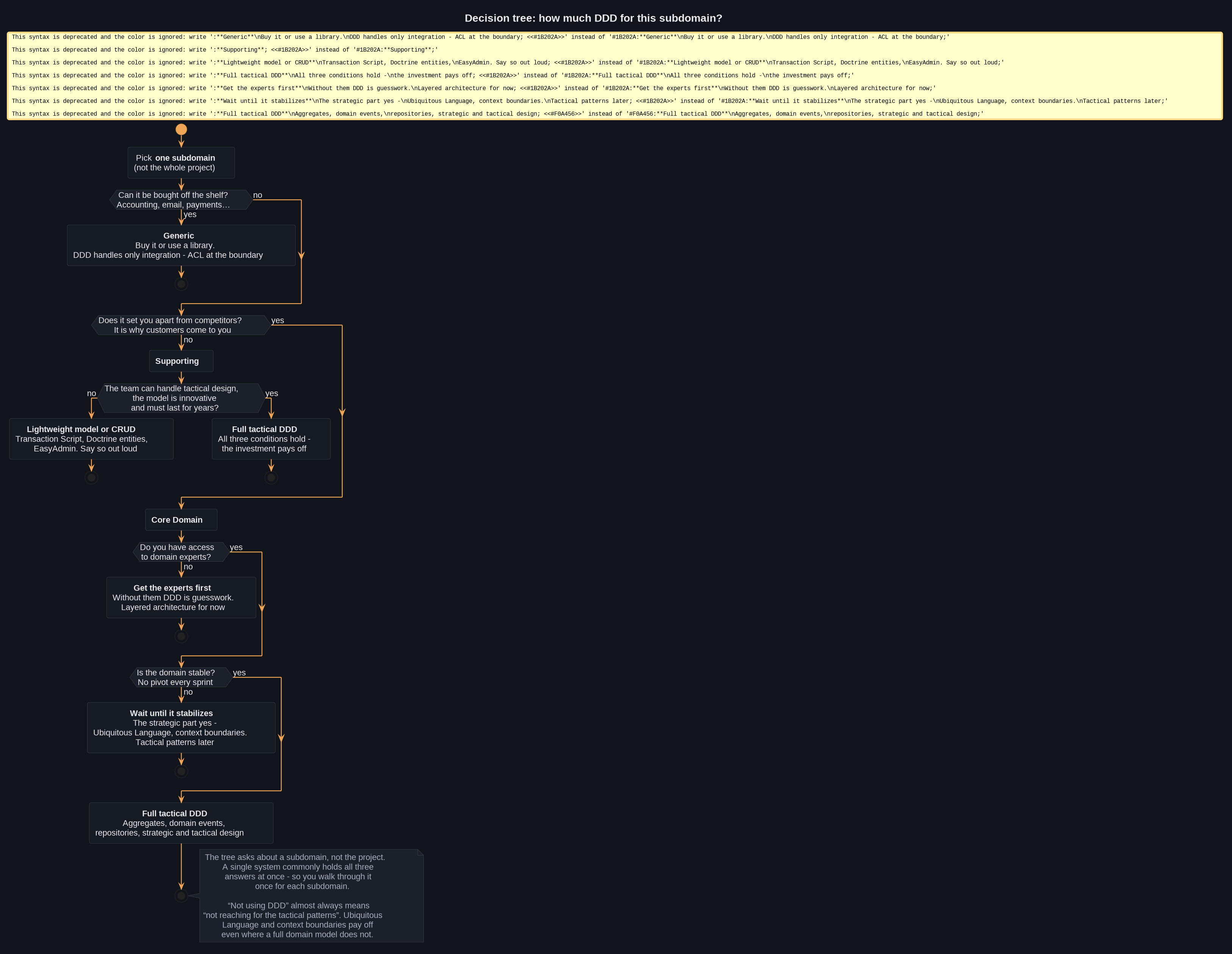
The question “should I use DDD?” is badly framed. A single system usually contains a part that decides its competitiveness, a part that nothing works without but nobody cares about, and a part you can buy. Each deserves a different answer. The tree below therefore asks about one subdomain, not the project, and you walk through it once for each.
It proceeds in three steps:
- Can the subdomain be bought off the shelf? Accounting, email delivery, a payment gateway. If so, it is Generic. Buy it. DDD handles only the integration, typically with an Anti-Corruption Layer at the boundary.
- Does it set you apart from the competition? If not, it is Supporting. A full tactical design pays off only
when three conditions hold (this book's own test): the team can handle it, the model is innovative,
and it has to last for years. Otherwise a lightweight model or plain CRUD is enough. The team has to
say so out loud, though, and not pass off a
Domain/directory as a domain model. - Is it the Core Domain? Then two gates remain, and they decide timing, not suitability: access to domain experts and the stability of the domain.
The classification of subdomains is covered in the chapter on subdomains, and the hybrid approach within a single system in the section Hybrid by subdomain type – DDD where it makes sense.
One more distinction applies throughout the chapter. In practice, “not using DDD” almost always means “not reaching for the tactical patterns”: aggregates, domain events, repositories. Ubiquitous Language, context boundaries, and domain mapping pay off even where a full domain model does not. The seven situations below concern the tactical layer unless stated otherwise.
22.02 1. CRUD admin and a simple back office#
An application where the user creates a record, edits it, and deletes it. The form maps 1:1 to a table. No domain logic, only persistence.
DDD would add aggregates, repositories, domain events, and value objects here for things that are naturally just rows in a database. The sample below puts a number on it: six classes instead of one, and no added value.
Eric Evans says it bluntly in the Core Domain pattern: The harsh reality is that not all parts of the design are going to be equally refined. Priorities must be set. A carefully refined model belongs where there is complex domain logic. CRUD operations have none. They read and write data without domain rules.
22.03 2. Startup – the domain changes every sprint#
You are looking for product-market fit. What is an order today is a subscription tomorrow. A customer turns into a partner overnight. The concepts are still being found, and a settled model that tactical patterns could capture does not exist yet.
DDD assumes you understand the domain well enough to model it. During the search phase that does not hold. Every refactoring of aggregates and Bounded Contexts slows you down, and development iterations focus on architecture instead of value for the customer.
The strategic tools of DDD, on the other hand, help in the search phase, especially Event Storming and Context Mapping. They give names to what you do not understand yet. What does not pay off is tactical DDD (aggregates, domain events, repositories) for a model that will change from the ground up next week.
22.04 3. A small team without domain experts#
DDD rests on collaboration between developers and customers, product managers, and analysts, that is, the people who understand the domain. Without them, you model the domain on your own, from your head, with no feedback.
The result is a model of how a developer imagines the business, not of how it actually runs. That is the opposite of what DDD is for. Vaughn Vernon stresses in Implementing Domain-Driven Design that without collaboration with domain experts, the Ubiquitous Language turns into mere technical jargon.
The key difference from situation 7: here you do not have domain experts on the team (a small team means developers do everything). In situation 7 the missing experts are not the only problem: the domain itself is unclear, and nobody knows what to model. The remedy differs too: here you need people, there you need knowledge.
22.05 4. Data pipelines, ETL, and reporting systems#
The system loads data from external sources, transforms it, and stores it or builds reports from it. It has no domain rules and no invariants. It moves data; it does not model a domain.
Aggregates protect invariants. If you have none, an aggregate is reduced to an empty wrapper with extra overhead. Evans defines an aggregate as a cluster of associated objects that we treat as a unit for the purpose of data changes. In the DDD Reference he adds that properties and invariants are defined for the whole and that enforcing them is the root's job. A pipeline has nothing to enforce: its rules live in the transformation step, not in the state of an object.
22.06 5. A project with a lifespan under a year#
An internal tool, a landing page, a one-off migration, a prototype for a customer demo. You write the code, use it, and throw it away.
The investment in DDD pays back on projects that live for years and grow. On short-lived projects the team pays the price of DDD (time, complexity, the learning curve) without ever reaping the benefits (maintainability, the ability to evolve).
Why a year? DDD requires an upfront investment: modeling the domain, building the Ubiquitous Language, designing aggregates and Bounded Contexts. That investment typically starts to pay back once the project grows and the team begins to benefit from clean domain boundaries. Projects that end within a year never get there.
The one-year figure is this book's estimate, not a measured quantity. In the Design Stamina Hypothesis, Fowler puts the payback line for design considerably lower, weeks rather than months. He adds himself that it is a hypothesis: we cannot measure either productivity or design quality. The difference lies in the subject. Fowler talks about design in general; this chapter is about the full tactical apparatus of DDD, which has a steeper learning curve and a higher entry overhead.
In Domain-Driven Design Distilled, Vernon turns this into a choice of where to direct effort: no organization can excel at everything, so it has to choose carefully what it wants to excel at. If your project is not where that choice falls, a full tactical design does not pay off there.
22.07 6. The team does not know DDD and there is no time to learn#
DDD requires the team to understand concepts such as aggregates, Bounded Contexts, domain events, and repositories. Misunderstood DDD is worse than no DDD: it produces pseudo-DDD code that carries added complexity without the architectural benefits. What such code looks like in detail is shown in the anti-pattern catalog, in Anti-pattern: anemic domain model.
“We'll learn as we go” on a production project with a deadline is a recipe for technical debt that will hurt for years.
22.08 7. The domain is unclear and experts are not available#
The customer does not know what they want. The requirements are vague. A domain expert either does not exist or has no time to collaborate. You end up modeling without solid ground.
The key difference from situation 3: in situation 3, people are missing. You have a small team without access to experts, but the domain itself may be clear (insurance, e-commerce…). Here nobody understands the domain, not even the would-be experts. Requirements are still taking shape, the concepts are not settled, and the domain rules change with every meeting.
DDD without knowledge of the domain is just renaming classes. “Order,” “Customer,” “Product” – it looks like DDD, but the model does not reflect the real domain. A year from now, once you understand the domain, you will rewrite everything anyway.
22.09 Hybrid by subdomain type – DDD where it makes sense#
The choice “all DDD or none” rarely matches the reality of a project. In Learning Domain-Driven Design (2021), Khononov chooses the pattern for business logic by its complexity, with the subdomain type as a guide. The simple logic of supporting and generic subdomains leads to Transaction Script, or to Active Record when the data structures are complex. Complex logic, typically in the Core Domain, gets a Domain Model, and when money or an audit trail is involved, its event-sourced form.
The table carries this heuristic over to Symfony: each Bounded Context gets as much DDD as its subdomain category calls for. “Lightweight DDD” in it is a simplification made by this book, not Khononov's term:
| Subdomain type | Architectural style | Reason |
|---|---|---|
| Core Domain | Full DDD (tactical + strategic patterns, aggregates, events) | Competitive advantage, complex rules, high ROI on the investment in the model |
| Supporting Subdomain | Transaction Script or Active Record; in Doctrine, lightweight DDD (entity + repository, no aggregate boundaries) | Rules exist, but they do not differentiate. Full DDD is over-engineering. |
| Generic Subdomain | CRUD or SaaS (auth, notifications) | It brings no competitive advantage; it gets bought, or an off-the-shelf solution is used. |
Active Record in the table comes from environments where the framework provides it. Doctrine ORM 3 is a Data Mapper and has no Active Record. The practical equivalent is a Doctrine entity with public setters, operated by a thin service class. This is not an anemic model in Fowler's sense, because no domain model is being built here at all: the logic deliberately lives in the service class as a Transaction Script. Choosing a style per context is covered in the chapter Architectural Styles.
A concrete case: an insurer has Core Underwriting (DDD yes), Supporting Customer Management (lightweight DDD), and Generic Notifications (CRUD or a SaaS such as Twilio). Full DDD in all three contexts means triple the overhead. In two of the three, that investment never pays back.
In a Symfony project, this shows in the structure of the monolith. src/Underwriting/ has the full
DDD structure: Domain, Application, Infrastructure, aggregates, and events.
src/Customer/ gets by with an Entity + Repository split. And src/Notification/
is pure EasyAdmin over Doctrine entities, or an external service altogether.
Five questions about domain complexity
You cannot tell the subdomain type from an org chart. Khononov offers questions for this that can be asked directly in a session with a domain expert:
- Do the experts describe the system in CRUD terms (“we create a customer, we update an order”)? Then the logic is most likely simple.
- Do the rules revolve mainly around input validation? Simple as well.
- Are there nontrivial calculations and algorithms in the domain? Complex.
- Are there invariants that must hold at all times and across several objects? Complex.
- How many scenarios does a single operation have, and how high would the cyclomatic complexity of its code be?
The borderline case has its own rule: if a Supporting subdomain is complex and that complexity has a business reason, it is most likely a Core subdomain in disguise. The opposite extreme is legitimate too. A project does not have to have any Core subdomain, and then a full domain model pays off nowhere.
Pseudo-DDD – a warning against cargo cult
The worst outcome is not “not using DDD.” It is pseudo-DDD: the team has the DDD directory
structure (Domain/, Application/, Infrastructure/) and uses the DDD vocabulary
in standups, but the domain model is anemic CRUD. The symptoms:
- Aggregates have getters, setters, and no behavior.
- Domain events get published, but no handler listens to them in the sense of domain logic, only for logging or auditing.
- Bounded Contexts exist as directories, but the team merely renamed them from the original
technical split (
UserModule/→UserBoundedContext/). - Code review discussions are about “is this proper DDD” instead of “does this change protect an invariant.”
Pseudo-DDD has all the costs of DDD (more code, a learning curve) and none of the benefits (invariants are not protected, the domain is not modeled). Fowler described the same balance sheet for the anemic model, and pseudo-DDD is its ceremonial variant. In this state, an acknowledged CRUD is the better choice. Remedy: admit that the domain has no complex logic, and simplify.
Evans has his own named answers to the question “where inside the system not to model.” Big Ball of Mud says to draw a boundary around the mess, give it a name, and keep sophisticated modeling out of it. Separate Ways covers the second case: integration costs more than it brings, so the contexts stay unconnected and each finds its own simple solution. Both are strategic decisions, not resignation.
The details are covered in the chapter on anti-patterns.
22.10 When DDD does make sense#
The conditions below are the other side of the decision tree's gates. Full tactical DDD at the level of an entire project pays off when all of them hold:
| Condition | Why it matters | Real-world example |
|---|---|---|
| Complex domain logic (not just CRUD) | DDD protects invariants and models rules – without rules it has nothing to protect | Insurance policies with 50+ domain rules for approval, insurance claims with a workflow |
| The project will live and grow for years | The investment in architecture pays back only over a long enough horizon | A core banking system, ERP, a healthcare information system |
| Access to domain experts | The Ubiquitous Language and the model are built through collaboration – not out of thin air | An actuary, an experienced accountant, a warehouse manager – people who live the domain every day |
| The team understands DDD or has time to learn | Badly implemented DDD is worse than no DDD | The team has been through training, has at least one DDD project behind it, or has 2–3 months to ramp up |
| Multiple Bounded Contexts or microservices | DDD provides natural boundaries for decomposing the system | E-commerce with separate contexts: catalog, orders, payments, logistics |
One condition failing does not mean an automatic “no.” Full DDD then does not belong in the whole system, and the decision moves to individual contexts according to their subdomain type. Where most of the five conditions do not hold, a simpler architecture is both the cheaper and the more honest choice.
The chapter can also be read the opposite way, so one last point: “no DDD” does not mean “no design.” In Domain-Driven Design Distilled, Vernon cites Douglas Martin: the alternative to good design is bad design, not no design. Flat MVC, a plain controller, and EasyAdmin all need modules, boundaries, naming, and tests. Fowler says the same about an architecture you plan to throw away one day: good modularity remains part of a healthy codebase even there.
The implementation of DDD in Symfony is covered in Implementation in Symfony 8, and the problems of introducing it in DDD in Practice – Where It Hurts. If you are introducing DDD gradually into an existing project, start with Migrating from CRUD to DDD.
Frequently asked questions
Is DDD worth it for a simple CRUD admin?
No. A CRUD admin that only maps a form to a database table lacks the domain logic DDD could protect. Putting aggregates, value objects, and repositories on top of plain “create/update/delete” adds complexity without matching value. In this situation, a direct CRUD implementation is the better choice, for example with EasyAdmin or API Platform. More in the CRUD admin and a simple back office section.
Does DDD make sense in a startup where the domain changes quickly?
Mostly not, as long as the startup is looking for product-market fit. DDD invests in precise modeling of the domain. When the domain gets overhauled every sprint, that investment is written off before it delivers any value. The more pragmatic path is to start with a simple architecture and introduce DDD selectively once the core of the product stabilizes and more use cases start sharing the same domain rules. The situation is analyzed in the Startup – the domain changes every sprint section.
What if the team has no experience with DDD?
Without DDD experience, a team typically produces an anemic model: the tactical patterns (aggregates, repositories, events) are used as empty wrappers around CRUD logic, while strategic design is missing. The result is a complicated architecture without real benefits. If there is no time to learn, it is better to start with a clean, well-structured CRUD architecture and add DDD elements gradually, as domain complexity grows. A detailed analysis is in the section on a team that does not know DDD and has no time to learn.
When does DDD make sense?
DDD pays off where several conditions come together. They include complex domain logic with many invariants, a long project horizon (years, not months), access to domain experts, and a team with enough experience or time to learn. Typical domains where DDD wins in the long run are core banking, insurance, healthcare, logistics, and regulated industries with rich rules. The decision should rest on the specific nature of the project and the team, not on the popularity of DDD. The decision criteria and domains are in the When DDD does make sense section.