Conway's Law and Team Topologies
In 1968, Conway observed that a system copies the communication structure of the organization that designs it. Bounded Contexts therefore work only when they line up with teams; otherwise you get boundaries that exist only on a diagram. This chapter shows how to design teams around the domain deliberately.
In this chapter
Most books on DDD stop at Bounded Context and Context Map, as if architecture lived in a vacuum. Once you have more than one team, though, the organizational structure starts shaping the architecture in its own image. Conway described this back in 1968; Team Topologies (Skelton & Pais 2019) adds a framework for designing teams deliberately. And one Bounded Context = one team is the first DDD rule your management will break.
05.01 Conway's Law#
In April 1968, the magazine Datamation published a short essay by Melvin Conway titled How Do Committees Invent? [1]. In it, Conway formulated an observation that later became known as Conway's Law:
“Organizations which design systems (in the broad sense used here) are constrained to produce designs which are copies of the communication structures of these organizations.”
– Melvin E. Conway, 1968
Conway prescribes nothing; he describes an observation. A separate frontend team and a separate backend team will produce a separate frontend and backend in the code as well.
Conway supports the thesis structurally. Each node of the design corresponds to one design group, and each branch between nodes corresponds to an interface two groups agreed on. In mathematical terms, there is a homomorphism between the graph of the system and the graph of the organization that designs it. An interface in code thus records an agreement between two groups of people.
Communication structure is not an org chart
Conway talks about communication structure, not about who reports to whom. The two coincide only where a formal hierarchy really determines who may talk to whom. This explains why militarily run organizations produce systems that resemble their org chart. Elsewhere, what matters is who works through problems with whom day to day.
Throughout this chapter, “team boundary” therefore means a team that delivers and is on call, not a box on an org chart. Team Topologies builds on the same distinction: the first chapter of the book is titled The Problem with Org Charts.
Three cases from practice
-
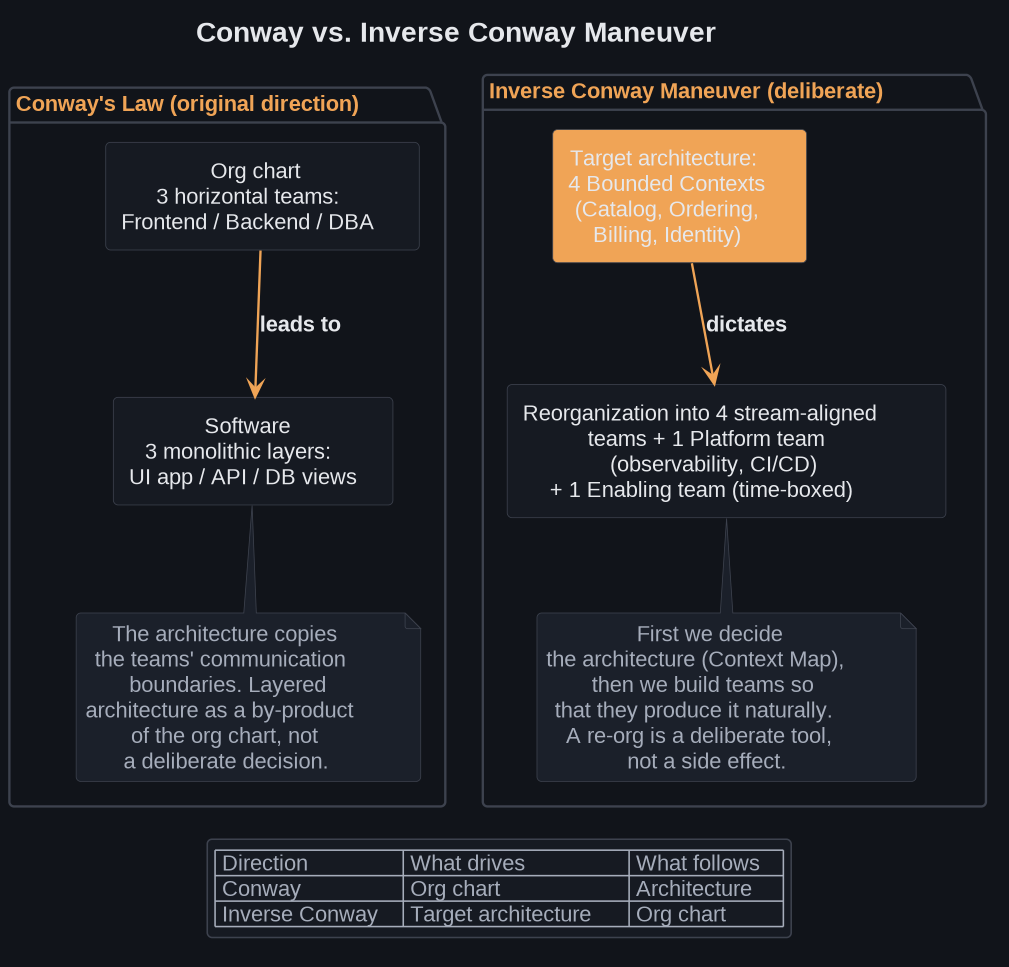
Teams split by layer → Layered Architecture. A company with 30 developers split into a “frontend team,” a “backend team,” and a “DBA team” will produce a three-tier architecture. Each team has its own release cycle, its own CI/CD pipeline, and its own sprint review. At best, the Bounded Context is an internal matter of the backend team; the frontend and DBA teams do not know it exists. Consequence: a change to a single domain requirement passes through all three teams and three sprints.
-
Teams split by product/stream → a microservice or module per BC. The same organization, reorganized into a “Catalog team,” an “Ordering team,” a “Billing team,” and a “Warehouse team,” will produce 4 microservices or 4 isolated modules in a monolith, one per Bounded Context. Each team is fully end-to-end: frontend, backend, DB, and DevOps. Conway's Law still applies; it only received different inputs.
-
A team without internal boundaries → Big Ball of Mud. Eight developers who all touch everything will not create any Bounded Contexts. The result is one monolith in which Customer in billing is the same class as Customer in marketing, only with more attributes. The classic consequence: after 18 months, nobody dares change anything, because “it could affect anything.”
05.02 Bounded Context = team boundary#
In Implementing Domain-Driven Design (2013, ch. 2) [2], Vaughn Vernon makes a recommendation that may be the most useful practical outcome of all of DDD: a Bounded Context should belong to a single team. The reverse, according to Vernon, is fine: one team can be responsible for several Bounded Contexts. He repeated the point in Domain-Driven Design Distilled (2016, ch. 2): multiple teams should not share one context.
Vernon does not present this as a law, though. He writes that the one-team-per-context rule should not restrict how flexibly teams are organized, and adds right away that a company should use its people as it needs to. Members of one team can help out on other projects. It is a preference (“it is best for”), not a ban on sharing people. The team as a whole owns the context, not each of its members full time.
The recommendation has two parts that are often misread as one:
-
One Bounded Context = one team (the default). When two teams share one BC, Conway's Law shows up immediately. Either an unofficial internal boundary emerges, which in effect means two BCs nobody has acknowledged. Or you get shared ownership: nobody owns the BC, and it degrades into a Big Ball of Mud. In practice: a shared BC is a temporary state with an end date, not the target form. Code that two teams genuinely need to share belongs in a small Shared Kernel between two separate BCs. Even that is an expensive relationship, not a default choice.
-
One team = one or more Bounded Contexts (allowed). A small team (5–9 people) can own 1–2 smaller BCs, exceptionally 3. The limit follows from cognitive load, which section 05.06 examines. A team that owns 5+ BCs is a signal to split.
For many organizations, the consequence is uncomfortable: in a healthy state, the Context Map and the Team Map are nearly isomorphic. With 7 BCs and 4 teams, you either have a mismatch (3 BCs have no owner) or one team owns 2+ BCs (a deliberate decision, not an oversight). The relationships on a Context Map are covered in detail in the chapter on Context Mapping.
And the other way around: with 4 BCs and 7 teams, the boundaries did not come from DDD but from a historical organizational structure nobody updated. That is where the Inverse Conway Maneuver comes in (section 05.05).
What to do when the Context Map and the Team Map do not match
A mismatch between the Context Map and the Team Map takes four forms, and each calls for a different action:
| Symptom | Cause | Action |
|---|---|---|
| BC without a team | The BC came from architecture on paper and was never assigned to anyone | Merge it with another BC or assign it to an existing team as its 2nd BC |
| Team without a BC | A horizontal team (frontend / DBA) with no domain responsibility | Inverse Conway: dissolve it and redistribute people into stream-aligned teams |
| BC shared by 2 teams | Organic growth without splitting the BC or the team | Either split the BC into 2 smaller ones + Customer/Supplier, or merge the teams |
| 1 team owns 5+ BCs | Accumulation without measuring cognitive load | Split the team (section 05.06) or reduce the number of BCs |
None of these scenarios is an acute crisis. Conway's Law gives the system enough inertia to keep running with the mismatch for months. In the long run, though, it shows: lead time grows, the share of deployments causing incidents rises, and morale drops. None of the cited sources offers a direct measurement of this chain; it is an observation from practice.
05.03 Team Topologies – 4 team types (Skelton & Pais 2019)#
In 2019, Matthew Skelton and Manuel Pais published Team Topologies: Organizing Business and Technology Teams for Fast Flow [3]. In it, they described systematically for the first time what types of teams an organization should have and how those teams should communicate. The book does not prescribe a process the way SAFe or LeSS do. It supplies a vocabulary for organizational design, something DDD lacks even in Vernon's treatment.
The second edition came out on September 23, 2025 [4]. The subtitle changed from “business and technology teams” to “business and technology,” and the framework now also reaches beyond IT. The authors promoted cognitive load to the main design principle and, together with Dr. Laura Weis, published a model for it with more than twenty factors in four groups. The text below is based on the first edition, on which the established terminology rests.
In 2024, Skelton added what he felt had gotten lost in the book: the four static team types matter less than the interactions between them and the way the topology evolves over time. Readers remember the four types because they draw well on a slide. What decides the outcome, though, are the interaction modes from section 05.04 and the willingness to rewrite the topology after six months.
Skelton and Pais distinguish 4 team types. Anything else (the classic “enterprise architecture team,” “QA team,” or “Center of Excellence”) is either a disguised variant of one of them or an organizational anti-pattern.
Stream-aligned team
The owner of an end-to-end value stream, typically one Bounded Context. A stream-aligned team has all the roles it needs to deliver changes to the end user on its own: developers (frontend and backend), QA, a designer, sometimes a product owner. It makes its own decisions, deploys, and runs its software in production, without handing anything off to another team.
- Size: 5–9 people. The authors derive the limit not from a pizza order but from Dunbar's trust thresholds (5, 15, 50, 150).
- Ownership: 1 BC (typically), at most 2–3 related small BCs.
- Goal: minimize cognitive load and maximize the flow of value.
- Measurement: DORA metrics; section 05.09 covers the current set.
In a healthy technology organization, most teams are stream-aligned. Skelton and Pais offer a tip on this: the ratio of stream-aligned teams to all others should be roughly 6:1 to 9:1. The figure did not come from measurement; it rests on what successful organizations report about themselves. As an order-of-magnitude check, though, it is enough. An organization with ten teams, three of them stream-aligned, typically suffers from one of the anti-patterns in section 05.08.
Platform team
Provides a self-service platform for stream-aligned teams. A platform team runs the internal developer platform (IDP). That includes CI/CD templates, the observability stack (Prometheus, Grafana, Sentry), Kubernetes, secrets management, templates for new BCs, and the developer portal.
The word that matters is self-service. A stream-aligned team does not file a ticket with the platform (“I need a new Postgres”) and wait a week. It provisions the database itself through the portal or deploys it through an IaC module the platform team maintains. When the platform works as a ticket queue, it becomes a bottleneck (an anti-pattern in section 05.08).
The authors do not define the platform as a single team but as a grouping of other teams that delivers a compelling internal product to stream-aligned teams. A large platform can therefore have its own stream-aligned teams inside it for individual services. The book gives no ratio such as “one platform team per hundred developers.”
The scope of the platform is set by the concept of the Thinnest Viable Platform: the platform should be only as thick as necessary. The smallest working TVP is a wiki page listing approved services and how to use them. Only when that stops being enough do you add automation, and people along with it.
- Character: the platform is a product. It has a roadmap, internal customers, and measured adoption. Without that, it is shared infrastructure under a new name.
- Measurement: NPS from stream-aligned teams, adoption rate, time-to-first-deploy for a new BC.
- Anti-character: a platform team does not approve changes. It enables other people's work rather than standing in its way as a gatekeeper.
Enabling team
A team of specialists that helps a stream-aligned team adopt a new technique or technology. Classic assignments: “teach them TDD,” “introduce CQRS,” “help with the migration to K8s,” “get event sourcing going with them.”
What is time-limited is the collaboration, not the team. The book speaks of a dependency that should end after a few weeks or months. The enabling team as a unit lives on and moves to the next stream-aligned team that is currently adopting something new.
An enabling team is often confused with a Center of Excellence, although the two differ substantially:
| Aspect | Enabling team | Center of Excellence (anti-pattern) |
|---|---|---|
| Length of collaboration with one team | Time-boxed, end agreed in advance | Permanent, no end planned |
| Goal | Hand over a skill and leave | Hold a checkpoint, approve |
| Relationship to the stream-aligned team | Mentor, peer | Reviewer, authority |
| Measure of success | The stream-aligned team can do it on its own | How many tickets we approved |
Complicated-subsystem team
Owns an algorithmically demanding domain that a stream-aligned team could not handle without dedicated specialists. Typical examples: a real-time risk engine in a bank, an ML scoring model, a video transcoder, a physics simulator, a compiler, a cryptographic library. The team concentrates specialized knowledge (a PhD in mathematics, physics, or CS, deep domain know-how) that cannot be spread across 6 stream-aligned teams.
- When it forms: only when a stream-aligned team objectively hits a ceiling.
- Communication: usually X-as-a-Service toward stream-aligned teams.
- Trap: a stream-aligned team becomes a “complicated subsystem” only because it has more senior staff. Seniority is not a reason; specialization is what counts.
Mapping DDD subdomains to team types
The subdomain classification (Core / Supporting / Generic) translates directly into team types. What the categories mean and how to recognize them is covered in the chapter on subdomains; only the team perspective remains here:
| Subdomain | Team type | Team consequence |
|---|---|---|
| Core | Stream-aligned (1 team per BC); Complicated-subsystem only if the domain is algorithmically demanding | Full control over design, deployment, and operations; the strongest staffing. |
| Supporting | Stream-aligned | Often shares a team with another supporting BC. Standard patterns, no over-engineering. |
| Generic | No dedicated team | The platform team integrates SaaS or an off-the-shelf solution. |
05.04 Three interaction modes between teams#
Alongside team types, Skelton and Pais define 3 (and only 3) permitted modes of interaction between them. Anything else (“someone over there will help you out,” “work it out somehow,” “send a ticket and we'll see”) is an informal relationship that Conway's Law immediately imprints into the code as an ad hoc interface.
Collaboration
Two teams work on a problem together, intensively. They share a backlog, plan together, and review each other's code. The mode is highly productive but expensive: it doubles meetings, blurs responsibility, and raises the cognitive load of both teams. That is why it is explicitly time-limited.
- When: during discovery of a new problem, during a major refactoring, when bootstrapping a new BC.
- When to end it: as soon as the interface is clear, the teams move to X-as-a-Service.
- Mapping to DDD: Partnership / Shared Kernel from the Context Map.
- Trap: permanent Collaboration → the two teams are in effect one team, and merging them only acknowledges it.
X-as-a-Service
One team uses another team's service as a black box through a stable API or contract. The consumer does not know the provider's internal structure or sprint plan. It has only an SLA, documentation, and release notes. In a mature organization, this is the default state of most relationships between teams.
- Mapping to DDD: Customer/Supplier or Open Host Service from the Context Map.
- Measurement: SLA, error rate, API availability, breaking-change rate.
- Goal: the minimum communication needed to use the service. No shared stand-up.
- Trap: X-as-a-Service requires a mature API and versioning. A provider that changes its API every sprint is running de facto Collaboration under a false label.
Facilitating
An enabling team helps a stream-aligned team acquire new know-how. The mode lasts weeks to months, with an end agreed at the start. It works interactively: pair programming, code review, workshops. The goal: the stream-aligned team will be able to do it on its own. Then the enabling team moves on to another stream-aligned team.
Facilitating has no direct equivalent on the Context Map, which deals with relationships between BCs, not skills inside a BC. Watch the time limit: Facilitating that lasts a year or longer in effect turns into a Center of Excellence.
Mapping to the Context Map has limits
The overlap between interaction modes and Context Map patterns is a useful shorthand, not an equation. Alberto Brandolini [5] puts the difference this way: Team Topologies describes a desirable target state, while Context Mapping offers finer-grained patterns for assessing the current one. A Context Map can therefore also name pathologies such as a Big Ball of Mud or an unwanted Conformist, for which Team Topologies has no mode.
A mode is not a permanent label either. Collaboration while bootstrapping a new BC should turn into X-as-a-Service once the interface is stable. Movement in the opposite direction, from X-as-a-Service back to Collaboration, signals that the boundary between contexts is wrong.
05.05 Inverse Conway Maneuver#
Conway's Law says “structure copies the organization.” The Inverse Conway Maneuver reverses the direction: if you want a different structure, you have to change the organization first. Conway's Law thus turns from an obstacle into a tool.
The term Inverse Conway Maneuver was coined by ThoughtWorks consultants Jonny LeRoy and Matt Simons in an article for the Cutter IT Journal (December 2010); Skelton and Pais (2019, ch. 2) elaborated on it, drawing on the research by Forsgren, Humble, and Kim in Accelerate (2018). The approach can be summarized in 4 steps:
-
Define the target architecture. Typically a Context Map from DDD, that is, a list of Bounded Contexts and the relationships between them. Without this step, there is nothing to copy. Details are in the chapter on Context Mapping.
-
Work out how many stream-aligned teams you need. Rule of thumb: 1 BC = 1 team. Six BCs mean six stream-aligned teams. With three current teams (frontend, backend, DBA), that implies a reorganization into six vertical teams, from existing people or through hiring.
-
Reorganize: dissolve horizontal teams, assemble vertical stream-aligned teams. This is the step where the maneuver usually fails. Frontend people do not want to be “on the Catalog team”; they want to sit with the other frontend developers. Managers do not want to trade a team of 12 for a team of 7. This phase needs strong backing from the CTO/VP of Engineering.
-
Sort out the platform. It typically forms from former “infrastructure” people and 1–2 seniors from each stream-aligned team. Its scope follows from need (Thinnest Viable Platform), not from the number of developers. Goal: self-service within 6 months, not a perfect IDP.
Skelton and Pais warn explicitly: an Inverse Conway Maneuver without management support will fail. Reorganization is a political act. When the CTO says “do it, but without changing the org chart,” you are in for 6 months of work that leads nowhere. Conway's Law will then pull the architecture back to the original communication structure with every refactoring.
The practical trap: reorganization hurts. People lose seniority, managers lose authority, and teams' established habits (the frontend coffee machine, the backend stand-up) break apart. A team lead considering an Inverse Conway Maneuver without an explicit mandate from the CTO should ask for one first. Section 05.09 covers communication with management.
When Inverse Conway does not work
The maneuver works as a change of direction, not as a one-off intervention. Martin Fowler [6] adds a caveat: for an existing system with an architecture set in concrete, reorganization does not bring an immediate fix. More likely, it creates a mismatch between developers and code that slows further changes. Fowler therefore recommends proceeding in small steps and watching feedback closely. In his view, the evolution of the architecture and the reorganization of people must go hand in hand throughout the life of the company.
For existing systems, the criticism goes further. The communication structure changes on the day of the reorganization; the codebase does not. The organization therefore goes through a period in which it is measurably worse than before the intervention. Teams wade through unfamiliar code, lead time grows, and the share of deployments causing incidents rises. Anyone who does not plan for this dip will read the numbers after three months as proof of failure and roll the reorganization back.
The checklist below therefore needs one more question that nobody likes to ask out loud: how long will the dip last, and who will explain it to leadership?
Practical checklist before launching an Inverse Conway Maneuver
Before starting a reorganization, go through the following list. A “no” to any item means Inverse Conway is premature and will usually fail:
-
Is there a canonical Context Map? Without one, there is no target architecture: step 1 has failed, and steps 2–4 have nowhere to go. So start there (the chapter on Context Mapping).
-
Does the reorganization have explicit support from the CTO / VP of Engineering? Reorganization is a political act. Without support from the top, you will not overcome the resistance. People will look for exceptions and restore the old structure unofficially.
-
Do you have 6 months? A reorganization shorter than 6 months typically does not work. People need time to move, to learn new domains, and to build new relationships.
-
Is there a plan for the platform team? Without a self-service platform, stream-aligned teams get stuck on infrastructure. Before the reorganization, the platform team must have at least a minimal IDP ready (creating a new BC with one click, a CI template, default observability).
-
Did you measure the DORA metrics before the reorganization? Without a baseline, you can neither defend success nor detect a regression. Four numbers are enough: lead time from commit to production, deployment frequency, change failure rate (the share of deployments that cause an incident), and the time to recover from a deployment that broke something.
-
Does the organization have a generative culture in Westrum's sense? In a pathological or bureaucratic culture, the reorganization happens formally, but the working relationships revert (section 05.09).
-
Is the “topology owner” role filled? Someone must lead the reorganization every day, typically a staff engineer + a manager. Without an owner, it dissolves into everyday sprint priorities.
With a “yes” on all seven items, your chances are better than average.
05.06 Cognitive load – the limit for team/BC size#
Skelton and Pais borrowed the concept of cognitive load from John Sweller's learning theory. Sweller introduced it in 1988 in a study on problem solving; the trio of types the theory uses today was added by Sweller, van Merriënboer, and Paas only in 1998. All three apply to software teams:
-
Intrinsic load – the complexity of the domain itself. A “banking risk engine” has a higher intrinsic load than a “product catalog.” It cannot be removed; it can be reduced through training and technology choices, or split across several teams.
-
Extraneous load – load from the environment, not the domain: unstable CI, poor platform documentation, 5 different deploy processes, chaos in Slack channels. Removing it is the platform team's job.
-
Germane load – the energy a team puts into learning and improving. This is the load that matters. When intrinsic and extraneous load overwhelm a team, germane load disappears and nobody invests in improvement anymore.
The goal according to Skelton and Pais: minimize intrinsic load, eliminate extraneous load, and leave the freed-up space to germane load. A team that spends 80% of its energy fighting CI and the deploy process has no capacity to improve the domain model.
How the authors themselves measure load
Skelton and Pais admit that no precise measure of cognitive load exists. Instead, they offer two things. The first is a single question put to the team: “Do you feel like you are effective and able to respond in a timely fashion to the work you are asked to do?”
The second is a relative estimate based on domain complexity. Domains are sorted into simple, complicated, and complex, and then a few heuristics apply. Each domain belongs to a single team. If a domain is too large for a team, the domain is split, not the responsibility for it. One team can carry two or three simple domains. A team with a complex domain gets nothing else. Two complicated domains on one team are a bad idea.
For DDD, the translation is direct: in this reasoning, a domain behaves like a Bounded Context. The chapter on subdomains offers a complexity classification, and the workshop described in the chapter on Event Storming yields candidate boundaries.
The cognitive load rule for the number of BCs per team
The following table is this chapter's own generalization; Team Topologies does not contain it in this form. It counts contexts instead of domains and adds a second dimension, team size:
| Team size | Recommended number of BCs | Comment |
|---|---|---|
| 5 people | 1 BC, or 2–3 small ones | Everyone has an overview of everything and knows every part of the code. |
| 6–9 people | 1–2 BCs (exceptionally 3) | The usual size of a stream-aligned team; everyone still knows everyone. |
| 10+ people | The team is already too large – split it | Dunbar's threshold for deep trust ≈ 15. Communication overhead grows quadratically with headcount. |
| Team with 5+ BCs | – | A signal to split. The BCs have no cohesive owner. |
How to measure cognitive load (a simple rubric)
The rubric below is a tool of this book, not a tool from Team Topologies. The authors publish a Team Cognitive Load Assessment template under CC BY-SA, but its public version does not include the wording of the questions. The rubric rests on the same idea: it collects the perceptions of team members, not technical numbers.
Using it takes little effort: a 30-minute workshop once a quarter. Each member rates five areas on a scale of 1–5 – domain and technical complexity (intrinsic), platform stability and documentation quality (extraneous, inverted), and room for learning (germane).
High scores on items 1+2 mean the team has its intrinsic load under control. High scores on items 3+4 show that the platform team works and extraneous load is low. A high score on item 5 indicates capacity for germane load.
If the average on item 5 is below 3, the team is in crisis mode: no new BCs, no new technologies. Stabilize extraneous load first.
Paste the template into docs/cognitive-load.md in the team's repository. It fits on a single A4 page and serves as input for the retrospective:
1# Cognitive Load Rubric – Q?/YYYY2 3Team: <team name>4Bounded Contexts owned: <list of BCs>5Team size: <N> people6Measurement date: YYYY-MM-DD7 8## 1. Domain complexity (intrinsic)9Question: “Do I fully understand the domain our team owns?”10Score 1–5: __11Comment: ____________________________________________12 13## 2. Technical complexity (intrinsic)14Question: “Do I understand all the technologies we use (language, framework, DB, broker)?”15Score 1–5: __16Comment: ____________________________________________17 18## 3. Platform stability (extraneous, inverted)19Question: “Can I rely on CI/CD, observability, and deploys without ad hoc fixes?”20Score 1–5: __ (5 = stable, 1 = every deploy is an adventure)21Comment: ____________________________________________22 23## 4. Documentation quality (extraneous, inverted)24Question: “Can I find the information I need in the internal documentation within 5 minutes?”25Score 1–5: __26Comment: ____________________________________________27 28## 5. Room for learning (germane)29Question: “Do I have at least 2 hours every sprint for improvement / learning / refactoring?”30Score 1–5: __31Comment: ____________________________________________32 33## Evaluation (filled in by the team lead after collecting responses from all team members)34 35Average of 1+2 (intrinsic capacity): __36Average of 3+4 (extraneous pressure): __37Item 5 (germane room): __38 39## Actions for the next quarter40 41- [ ] If item 5 < 3 → stop adding BCs.42- [ ] If items 3+4 < 3 → escalate to the platform team (extraneous load).43- [ ] If items 1+2 < 3 → consider splitting a BC or adding a team member.44- [ ] If > 4 BCs owned → plan a split within 2 quarters.The rubric deliberately measures team members' perceptions. Cognitive load is a psychological category, and no hard metric from Grafana captures it. Skelton and Pais (2019, ch. 3 “Team-First Thinking”) go further: they call attempts to determine the cognitive load of software from simple measures, such as the number of lines of code, modules, classes, or methods, misguided. In their view, languages differ in verbosity, so line counts in a polyglot system are not comparable. What matters is how much cognitive capacity the team has for making effective changes to the system, not how large the system is.
05.07 Practical scenarios (5 / 20 / 200+ people)#
Team Topologies does not prescribe introducing all four team types and three modes right away. It serves as a language for describing the current state and the goal. The concrete form depends on the size of the organization.
Scenario A – Startup, 5 people, 1 product
Recommendation: 1 stream-aligned team, 2–3 small BCs in one monolith (a modular monolith). No platform team, no enabling team.
- Architecture: one Symfony monolith; BCs are folders/modules with explicit interfaces (the chapter DDD and Microservices).
- Generic subdomains: buy them as SaaS, no in-house implementation. The arguments and the build/buy sourcing strategy are covered in the chapter on subdomains.
- Hosting: Upsun (formerly Platform.sh), Heroku, Railway, Fly.io. Managed services replace a platform team.
- What to avoid: Kubernetes, a custom observability stack, microservices. It is too early for those.
The startup mistake: copying an enterprise architecture “so it is ready for the future.” A five-person team does not have the cognitive capacity for 6 microservices.
Scenario B – Scale-up, 20 people, 1 product with growing complexity
Recommendation: 2–3 stream-aligned teams by BC + 1 mini platform team (3–5 people) for CI/CD and observability. No permanent enabling team.
- Stream-aligned teams: split by the main value streams. For example, a Catalog team (5 people), an Ordering team (6 people), and a Billing team (4 people, sharing 2 supporting BCs: Billing and Warehouse). Identity is Generic: it runs on an external IdP, and the platform team maintains a thin bridge to it.
- Platform team: 4 people, owns the CI pipeline template, the K8s cluster, Grafana/Sentry, and the template for a new BC. Self-service.
- Enabling team: not a permanent one. An external consultant covers the introduction of CQRS for 3 months.
- Interaction modes: stream-aligned teams use X-as-a-Service among themselves. The platform team is in X-as-a-Service with everyone. Occasional Collaboration when bootstrapping a new BC.
This phase is the riskiest. The organization is no longer small, but it does not yet have the capacity for the full scope of Team Topologies. The classic mistake: a Center of Excellence (an “architecture board”) forms and becomes a bottleneck.
Scenario C – Enterprise, 200+ people, 10+ BCs
Recommendation: the full Team Topologies structure.
- 15–25 stream-aligned teams of 6–9 people each, each owning 1 BC (or 2 related supporting BCs).
- 1–2 platform teams – typically 1 main one (IDP, K8s, observability) + sometimes a specialized one (data platform, ML platform).
- 1–3 enabling teams – rotating, time-boxed, according to current needs (e.g., a “security enabling team” for 6 months, an “event sourcing enabling team” for 3 months).
- 1–2 complicated-subsystem teams – only for objectively specialized domains (e.g., a risk engine in a bank, a video transcoder in media, ML scoring in ad tech).
- Topology design: at this size, a small topology team (1–2 people, not a Center of Excellence) proves its worth. It tracks teams' cognitive load and proposes reorganizations. It is often a staff engineer + a manager.
Even in a company of two hundred, stream-aligned teams should clearly predominate, roughly three quarters of the people. If 100 of 200 people sit in platform/enabling/CoE teams and architecture roles, you have a problem. Stream-aligned teams carry the domain value; the others only multiply it.
05.08 Anti-patterns#
The following five anti-patterns are among the most common and most expensive in practice. A detailed catalog of DDD anti-patterns is in the separate chapter on anti-patterns.
1. “We share one monorepo without module boundaries”
Several teams commit to one repository without clear boundaries between modules. Every non-trivial change by one team then requires code review from the others (“just to make sure it doesn't break anything”). The second team effectively has a veto over the first team's changes.
Solution: module boundaries enforced in CI, not by agreement at a retro. In PHP, Deptrac or PHPArkitect does the job: the build of a pull request that reaches from one team's module into another's fails. The chapter DDD and Microservices shows concrete rules. Add ownership recorded in CODEOWNERS. The alternative is a separate repo for each BC. The principle of “everyone in one repo, we'll work it out somehow” does not work.
2. “Frontend / Backend / Mobile teams”
The classic anti-pattern straight out of Conway's Law: teams split by layer. Every new feature requires coordinating 3 teams, 3 sprints, and 3 retrospectives. A change worth roughly 3 days of work has a lead time of more than 6 weeks.
Solution: the Inverse Conway Maneuver. Dissolve the horizontal teams and assemble vertical stream-aligned teams. Each team has all the roles it needs (frontend dev + backend dev + mobile dev + QA + designer). If the mobile app is a core part of the product rather than a side channel, mobile developers belong in the stream-aligned teams, not in a separate “mobile team.”
An exception: with one or two mobile developers in the entire organization, a temporary “mobile guild” fits – not as a team with its own backlog, but as a community for sharing knowledge.
3. A “Center of Excellence” instead of an enabling team
A permanent unit of “architects” / “experts” / a “lead team” that holds approval authority over the others. The typical corporate form: an ARB (Architecture Review Board) that must approve every new service.
What is wrong: a CoE typically works as a checkpoint, not as expert support. Approval by its nature slows things down, creates a queue, and relieves stream-aligned teams of responsibility (“they didn't approve it, it's not our fault”).
Solution: CoE → enabling team. Time-limited collaboration, mentoring instead of approval, dissolution after handover. If “approval” is necessary, the stream-aligned team does it itself against documented standards, not an external board.
4. “The platform team as a gatekeeper / ticket queue”
The platform team works as infrastructure ticket support. A stream-aligned team needs a new Postgres, creates a JIRA ticket, and waits 5 days. It needs to adjust the CI pipeline, creates a ticket, and waits a week. The platform team has become the bottleneck of the entire organization.
Solution: the platform team must deliver self-service interfaces (CLI, portal, IaC modules). When a stream-aligned team has to file tickets, that is a flaw in the platform's design, not in the team filing them.
The main metric: time-to-first-deploy for a new BC. In a healthy organization, under 1 day. In an unhealthy one, “we'll try it in a month, once the platform team has capacity.”
5. “A Bounded Context shared between 2 teams”
Two stream-aligned teams commit to the same Bounded Context because “it makes sense.” Conway's Law reacts immediately. An informal internal boundary emerges, an “ours/yours” line in the code, but without a formal Context Map. The line hardens, and after six months it has become a Big Ball of Mud with two owners.
Solution: split the BC into 2 smaller BCs with a Shared Kernel (expensive, see Context Mapping) or a Customer/Supplier relationship. Alternatively, merge the 2 teams into 1 larger one if the domain cannot be split.
05.09 Communicating with management – how to sell a reorganization#
The Inverse Conway Maneuver is a deep organizational change: teams split, managers are reassigned, and people may lose seniority or “their corner.” Without management support (CTO, VP of Engineering, People Ops), it will fail.
Management is addressed in its own language, not the language of DDD. Managers do not value a “more accurate domain model” or “more clearly bounded Bounded Contexts”; they value metrics.
Arguments that work (DORA metrics)
In Accelerate (2018) [7], Nicole Forsgren, Jez Humble, and Gene Kim published 4 metrics (DORA). They measure the effectiveness of software delivery and correlate strongly with business outcomes (profit, growth, customer satisfaction).
The set has shifted since 2018 [8]. In 2023, MTTR was renamed failed deployment recovery time, and its definition changed too: the metric measures recovery from a failure caused by a change in production, not from any outage. In 2024, a fifth metric was added. The current form:
- Change lead time – the time from commit to production. Stream-aligned teams: hours. Horizontal teams: days to weeks.
- Deployment frequency – how often you deploy. Stream-aligned: several times a day. Horizontal: once per sprint.
- Failed deployment recovery time – the time to recover from a deployment that broke something. In Accelerate, still under its historical name, MTTR.
- Change failure rate – the share of deployments that cause an incident.
- Deployment rework rate – the share of unplanned deployments triggered by an incident.
The first three metrics describe throughput, the last two instability. Which year's version of the set you use matters less. What matters is measuring identically defined numbers twice: before the reorganization and six months after it. Nobody knows in advance how far the numbers will move. Promising the CTO a specific percentage of improvement means creating a problem for yourself six months later. What you can promise is a baseline, a date for the second measurement, and a decision based on the result.
Arguments that do not work
- “Eric Evans would want it.” A manager is not part of the DDD community.
- “It's more elegant” – nobody measures elegance.
- “Bounded Contexts are canonical.” Canonicity does not interest a manager.
- “It will get better,” except that without a metric, “better” is an empty word.
- “Skelton and Pais say so.” Authority alone is not enough.
Westrum's organizational culture
In 2004, sociologist Ron Westrum published a typology of organizational cultures [9], which Forsgren later used in Accelerate as a predictor of software delivery performance. Westrum distinguishes 3 types:
| Aspect | Pathological (power-oriented) | Bureaucratic (rule-oriented) | Generative (performance-oriented) |
|---|---|---|---|
| Cooperation | Low | Modest | High |
| Failure | Leads to scapegoating | Leads to justice | Leads to inquiry into causes |
| New ideas | Crushed | Lead to problems | Implemented |
| Messengers of bad news | Shot | Neglected | Trained |
Team Topologies works only in a generative culture. In a pathological culture (the manager punishes mistakes, hierarchy is everything), stream-aligned teams will not get autonomy. Leadership wants a checkpoint, so the platform team turns into a gatekeeper. In a bureaucratic culture (precise roles, formal processes), the reorganization goes through, but the working relationships stay the same. Conway's Law returns through formal approvals.
In a pathological or bureaucratic organization, change therefore does not start with the Inverse Conway Maneuver but with culture. Or with a change of employer.
05.10 Summary#
Conway's Law from 1968 says that architecture copies the communication structure of the organization. For DDD, this means: a Bounded Context without an owning team is a fiction. Contexts on the Context Map for which you cannot name a team that delivers them do not exist. They are only written down in the documentation.
Team Topologies (Skelton & Pais, 2019) is a framework for designing teams deliberately, and it complements DDD where Vernon and Evans are silent. The main takeaways:
- 4 team types: Stream-aligned (owns a BC end-to-end, the default), Platform (a self-service product, not a single team), Enabling (mentoring with an agreed end to the collaboration), and Complicated-subsystem (an objectively specialized domain).
- 3 interaction modes: Collaboration (expensive, time-limited), X-as-a-Service (the default mature relationship), and Facilitating (time-boxed mentoring).
- Vernon's preference: 1 BC = 1 team; a BC shared between teams is a temporary state, not the target. Vernon gives no number for how many contexts one team can carry – the range of 1–2, exceptionally 3, is this book's own generalization.
- Subdomains → team types: Core → stream-aligned (the best team) / complicated-subsystem; Supporting → stream-aligned (shares a team with another supporting BC); Generic → SaaS, integrated by the platform team.
- Inverse Conway Maneuver: first define the target architecture, then build teams so that they produce it naturally. Without CTO support, it will fail.
- Cognitive load: 1–2 BCs (exceptionally 3) per 5–9 people. 5+ BCs per team = a signal to split. Measured quarterly.
- Proportions: roughly 75% stream-aligned, 15% platform, 10% enabling + complicated-subsystem (this book's own generalization, see 05.07).
- Communicating with management: DORA metrics, not DDD philosophy. Westrum's generative culture is a prerequisite, not an outcome.
A Bounded Context is a specific team's commitment to develop, deploy, and fix its part of the domain at night. Without that commitment, it remains a folder in the repo.
For deeper study, there is Team Topologies by Skelton and Pais [3] and chapters 2 and 3 of Vernon's Implementing Domain-Driven Design [2]. DORA metrics and Westrum's typology are covered in Accelerate by Nicole Forsgren et al. [7]. Conway's original 1968 essay is only 4 pages long and worth reading [1].
Frequently asked questions
What if we have only one team? Does Team Topologies apply to us too?
Yes, but in a simplified form. A single stream-aligned team (5–9 people) is a full-fledged organizational structure, typical for a startup. You have no platform team (managed services such as Upsun/Heroku/Stripe/Auth0 replace it), and no enabling team either (if needed, you hire an external consultant for 3 months). For you, Team Topologies only addresses the internal arrangement of the team: splitting six people into a “mini frontend / mini backend” makes no sense. Details in Scenario A.
Can I have 1 team that owns 5 Bounded Contexts?
Perhaps in the short term, not in the long term. Vernon (2013) allows that one team can own several BCs; he does not say how many. This book recommends 1–2, exceptionally 3. With 5 BCs, you run into cognitive load (section 05.06): the team loses track of the details of each BC, code quality drops, and lead time grows. A practical heuristic: if you have 5 BCs on one team, plan to split it into 2 teams within 6 months. If you do not have the people for 2 teams, reduce the number of BCs (merge them into a superset, or move Generic subdomains to SaaS).
How does Team Topologies relate to the Spotify Model?
The Spotify Model (squads, tribes, chapters, guilds) was described by Henrik Kniberg and Anders Ivarsson in 2012 with an explicit note that it was a snapshot of how they worked at the time, not a prescription. It became a prescription anyway. Jeremiah Lee, a former Spotify product manager, argues in his 2020 essay Spotify's Failed #SquadGoals that the model was largely aspirational and that the company succeeded despite it rather than because of it. Parallels exist: stream-aligned team ≈ squad, while chapters and guilds correspond to knowledge-sharing communities beyond the topology. A tribe (a collection of squads around a domain area) matches in size the Dunbar thresholds of 50 and 150 that Team Topologies works with. The main difference lies in the nature of the two: the Spotify Model describes one company in one period, while Team Topologies provides a framework with named team types and interactions.
Is Team Topologies worth it in a fifty-person company?
Yes, but not in its full form. A fifty-person company sits between Scenarios B and C, closer to the scale-up: typically 4–6 stream-aligned teams + 1 mini platform team (3–5 people). No permanent enabling team, no complicated-subsystem team (unless you are a bank or an ML startup). At this size, the main value of Team Topologies is its language. Once people start talking about a “platform team” and a “stream-aligned team,” it becomes clear who does what, what is a ticket queue, and what is self-service. Scenario B describes the starting point.
What should we do when management does not agree with a reorganization?
Three options, depending on severity. (1) Gradual shift: do not reorganize all at once; instead, influence the boundaries “under the hood”: module boundaries in the monorepo, code owners, independent deployments. Some of the handoffs disappear even without a formal reorganization. (2) Stream-aligned team pilot: convince management to try one pilot team (5–7 people) for 6 months. Measure the DORA metrics before and after. If the pilot succeeds, you have an argument for the full reorganization. (3) Diagnosing the culture with Westrum: if the organization is pathological or bureaucratic (section 05.09), Team Topologies will fail even with a formal reorganization. Consider changing jobs. Details on communicating with the CTO are in section 05.09.
What is the relationship between Team Topologies and microservices?
Team Topologies does not address microservices, but microservices without a well-thought-out team topology usually lead to a distributed monolith. A microservice is a physical deployment boundary; a stream-aligned team is an organizational boundary of responsibility. In a healthy state, team and BC coincide: 1 stream-aligned team = 1 BC. The context then runs as a separate microservice or as a module in a modular monolith; that is an operational decision. With 30 microservices and 5 teams, you do not have a microservices architecture but a distributed monolith: each team “owns” 6 services, and no boundary has a cohesive owner. The chapter DDD and Microservices covers this in detail.
05.11 Further reading and cited sources#
The numbering matches the references in the text; items 10–14 are supplementary reading.
-
Conway, M. E. (1968). How Do Committees Invent? Datamation, 14(4), 28–31. melconway.com
-
Vernon, V. (2013). Implementing Domain-Driven Design. Addison-Wesley. Ch. 2 (Domains, Subdomains, and Bounded Contexts) and ch. 3 (Context Maps). amazon.com
-
Skelton, M. & Pais, M. (2019). Team Topologies: Organizing Business and Technology Teams for Fast Flow. IT Revolution Press. teamtopologies.com
-
Skelton, M. & Pais, M. (2025). Team Topologies: Organizing business and technology for fast flow of value, 2nd edition. IT Revolution Press. itrevolution.com
-
Brandolini, A. (2021). About Team Topologies and Context Mapping. Avanscoperta Blog. blog.avanscoperta.it
-
Fowler, M. Conway's Law. Bliki – attribution of the Inverse Conway Maneuver and caveats about its effectiveness. martinfowler.com
-
Forsgren, N., Humble, J. & Kim, G. (2018). Accelerate: The Science of Lean Software and DevOps. IT Revolution Press. itrevolution.com
-
DORA. A history of DORA's software delivery metrics. How the set of metrics has evolved since 2018. dora.dev
-
Westrum, R. (2004). A typology of organisational cultures. Quality and Safety in Health Care, 13(suppl_2), ii22–ii27. qualitysafety.bmj.com
-
Yegge, S. (2011). Stevey's Google Platforms Rant. The source of the account of Bezos's 2002 API mandate. gist.github.com
-
Vernon, V. (2016). Domain-Driven Design Distilled. Addison-Wesley. Ch. 2 (Strategic Design with Bounded Contexts and the Ubiquitous Language).
-
Evans, E. (2003). Domain-Driven Design: Tackling Complexity in the Heart of Software. Addison-Wesley.
-
Tune, N. & Perrin, J.-G. (2024). Architecture Modernization: Socio-technical alignment of software, strategy, and structure. Manning. Combines strategic DDD, Event Storming, and Team Topologies into a single approach.
-
Related chapters: Subdomains: Core, Supporting, Generic, Bounded Context and Context Mapping, Architectural Styles, Anti-Patterns and Common Mistakes.